---
title: "Teaching About AI, Teaching With AI: Navigating the Future of Education"
description: Explore how schools can teach about AI responsibly, build AI literacy, and prepare students for an AI-influenced world with clear, ethical learning approaches.
image: https://blogs.codeavengers.com/hubfs/Screenshot%202026-02-10%20at%208.37.30%20PM.png
---
[](https://www.codeavengers.com)
- Learn + Tech
Show submenu for Learn + Tech
- [Coding for Kids](https://www.codeavengers.com/jr)
- [Digital Skills for Ages 12+](https://www.codeavengers.com/pro)
- [Code Avengers in Schools](https://www.codeavengers.com/edu)
- [Professional Development for Teachers](https://www.codeavengers.com/pd)
- Impact
Show submenu for Impact
- [Customer Success](https://blogs.codeavengers.com/content/tag/customer-success)
- [Global Reach](https://www.codeavengers.com/global-reach)
- [Indigitech](https://www.codeavengers.com/indigitech)
- [Testimonials](https://www.codeavengers.com/testimonials)
- Explore
Show submenu for Explore
- [Our Community](https://code-avengers.mn.co/share/ILDeNr0PWnDxIqQp?utm_source=manual)
- [Blog](https://blogs.codeavengers.com/content)
- [About Us](https://www.codeavengers.com/about)
- [Contact Support](https://www.codeavengers.com/support)
- Events
Show submenu for Events
- [Cyberscape 2026](https://www.codeavengers.com/events/cyberscape-2026)
- [Digital Navigators](https://www.codeavengers.com/digital-navigators)
- Learn + Tech
Show submenu for Learn + Tech
- [Coding for Kids](https://www.codeavengers.com/jr)
- [Digital Skills for Ages 12+](https://www.codeavengers.com/pro)
- [Code Avengers in Schools](https://www.codeavengers.com/edu)
- [Professional Development for Teachers](https://www.codeavengers.com/pd)
- Impact
Show submenu for Impact
- [Customer Success](https://blogs.codeavengers.com/content/tag/customer-success)
- [Global Reach](https://www.codeavengers.com/global-reach)
- [Indigitech](https://www.codeavengers.com/indigitech)
- [Testimonials](https://www.codeavengers.com/testimonials)
- Explore
Show submenu for Explore
- [Our Community](https://code-avengers.mn.co/share/ILDeNr0PWnDxIqQp?utm_source=manual)
- [Blog](https://blogs.codeavengers.com/content)
- [About Us](https://www.codeavengers.com/about)
- [Contact Support](https://www.codeavengers.com/support)
- Events
Show submenu for Events
- [Cyberscape 2026](https://www.codeavengers.com/events/cyberscape-2026)
- [Digital Navigators](https://www.codeavengers.com/digital-navigators)
[Log In](https://account.codeavengers.com/login)
[Start For Free](https://account.codeavengers.com/signup)
Featured Post
# Learn Python With Code Avengers

Written By [Hannah Taylor](https://blogs.codeavengers.com/content/author/hannah-taylor)
June 17, 2016
[Read Article](https://blogs.codeavengers.com/content/learn-python-with-code-avengers)

Written By [Hannah Taylor](https://blogs.codeavengers.com/content/author/hannah-taylor)
June 17, 2016
[ back](https://blogs.codeavengers.com/content)
# Teaching About AI, Teaching With AI: Navigating the Future of Education

Written By [Natalie Li](https://blogs.codeavengers.com/content/author/natalie-li)
March 03, 2026

Written By [Natalie Li](https://blogs.codeavengers.com/content/author/natalie-li)
March 03, 2026
### Teaching About AI, Teaching With AI: Navigating the Future of Education
Artificial Intelligence (AI) is shaping many aspects of modern life, from how we communicate and work to how decisions are made across industries. In education, this raises important questions: not just about *how* AI can be used, but *whether*, *when*, and *why* it should be.
For educators, students, and families, understanding AI is becoming part of digital literacy. At the same time, schools are carefully considering how emerging technologies fit alongside pedagogy, curriculum goals, equity, and wellbeing.
This article explores two distinct but connected ideas: **teaching about AI** and **teaching with AI**, and why keeping that distinction clear matters.
##### Teaching *About* AI: Building Understanding and Critical Awareness
AI literacy is increasingly important as young people navigate a digital world filled with AI-generated images, videos, voices, recommendations, and automated decisions. From social media feeds to image generators, chatbots, and deepfakes, AI is no longer abstract. It influences what people see, hear, and trust.
Teaching about AI helps students make sense of this landscape. Rather than focusing on tools alone, it builds understanding so learners can recognise where AI is used, how it works at a basic level, and what its limitations are.
In practice, teaching about AI often includes exploring concepts such as:
- **What AI is and is not**
Understanding that AI systems do not think or reason like humans, but operate by identifying patterns in data and producing outputs based on statistical models and programmed processes.
- **Data and training**
Learning how AI systems are trained using datasets, and how the quality, scope, and bias of that data can shape outcomes.
- **Algorithms and decision-making**
Exploring how AI systems make predictions or classifications, and why AI outputs should be questioned rather than treated as facts.
- **Bias, error, and limitations**
Examining real examples where AI systems produce biased, misleading, or incorrect results, and discussing why this happens.
- **Ethics and responsibility**
Considering questions around accountability, transparency, privacy, consent, and the social impact of AI systems.
By engaging with these ideas, students move beyond surface-level use of AI tools and develop the ability to question, evaluate, and contextualise AI-driven technologies.
At Code Avengers, AI learning is designed to be **conceptual, contextual, and critical**, not just technical. Courses introduce these ideas through age-appropriate scenarios, interactive tasks, and guided discussion, helping students explore AI as a human-created technology shaped by design choices and values.
##### Teaching *With* AI: Supporting Professional Practice
Teaching with AI is not about replacing professional judgement. Effective learning still depends on strong pedagogy, curriculum knowledge, and an understanding of your learners.
In education, AI is most useful when it supports thinking and planning rather than generating finished outcomes. Used carefully and within school policies, AI tools can help teachers work at a higher level, while keeping decision-making firmly in human hands.
In practice, this might include using AI to:
- generate initial ideas or starting points for lesson structures, which teachers then critique, adapt, and refine
- summarise large amounts of information to support planning at a unit or concept level
- explore alternative explanations or examples for a concept when planning differentiation
- reflect on patterns in student work or assessment data to inform next teaching steps
In each case, professional expertise is essential. AI outputs are only as useful as the teacher’s ability to evaluate accuracy, relevance, bias, and suitability for their students.
At Code Avengers, our courses and teaching resources are developed by experienced educators, with a focus on clarity, progression, and pedagogical integrity. Where AI is discussed or explored, it is treated as a subject to be understood and questioned, not as a shortcut for teaching or learning.
This approach helps schools engage with AI in ways that are transparent, ethical, and educationally sound, while protecting the role of teachers as designers of learning.
##### How Code Avengers Fosters Responsible AI Learning
One of the ongoing challenges in education is balancing innovation with workload, clarity, and confidence. Well-designed teaching resources can help reduce pressure without introducing unnecessary complexity or risk. Code Avengers supports both **learning about AI** and **teaching with digital tools** through structured courses and teaching resources designed for classroom use. Our courses are designed by, and in consultation with, experienced teachers.
Rather than relying on generative tools to produce answers, Code Avengers courses focus on:
- step-by-step learning progressions, with clear learning goals and sequences
- unplugged activities and discussion prompts
- interactive practice with immediate feedback
- projects that require reasoning, testing, and reflection
- opportunities to discuss ethics, bias, and real-world impact
For teachers, lesson plans and supporting resources help extend learning beyond screens, incorporate discussion and unplugged activities, and maintain clarity around what students are expected to learn and demonstrate.
This approach helps schools engage with AI in ways that are educationally sound, transparent, and aligned with curriculum goals. Through Code Avengers, AI is taught **as a topic to understand**, rather than a shortcut that bypasses learning.
##### Preparing Students for an AI-Influenced World
Students do not need to become AI engineers to benefit from AI education. What they do need are:
- foundational digital and computational thinking skills
- the ability to question how technology works
- awareness of bias, data use, and ethical trade-offs
- confidence navigating complex digital systems
Teaching about AI helps students become informed participants in a digital society, capable of making thoughtful decisions rather than passively accepting technological change.
##### A Balanced Approach to AI in Education
AI is shaping the world students are growing up in. Education plays a critical role in helping them understand it, question it, and use it responsibly.
By teaching about AI and carefully considering how digital tools can support learning, educators can prepare students for an AI-influenced future without compromising pedagogy, equity, or integrity.
If you’d like to explore how Code Avengers supports AI learning in schools, you can start with a free account or classroom trial.
[Explore Code Avengers today.](https://account.codeavengers.com/signup)
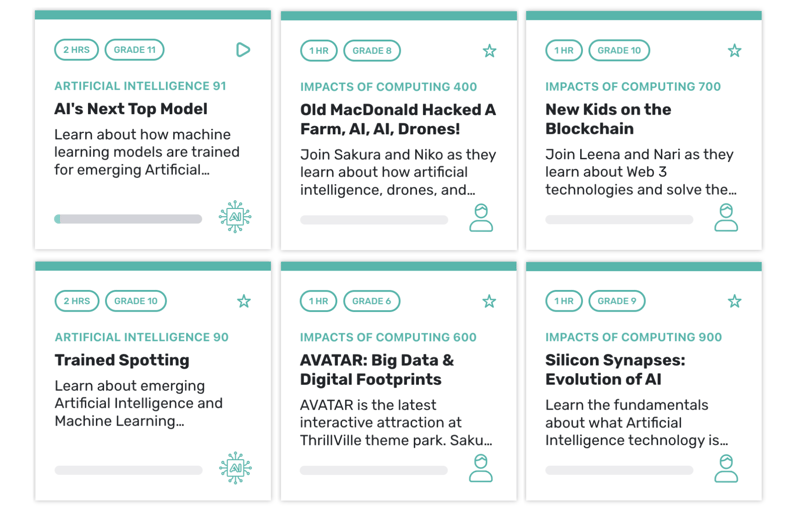
*AI courses to look out for on Code Avengers:*
[](https://www.codeavengers.com)
[Follow us on Facebook](https://www.facebook.com/CodeAvengers/) [Follow us on Twitter](https://x.com/codeavengers) [Follow us on YouTube](https://www.youtube.com/channel/UC7HKtyaPf9UmzQLuQnRzmpg/videos) [Follow us on Instagram](https://www.instagram.com/code_avengers/) [Follow us on Linkedin](https://www.linkedin.com/company/code-avengers/)
Learn + Teach
[Coding for Kids](https://www.codeavengers.com/jr)
[Digital Skills for Ages 12+](https://www.codeavengers.com/pro)
[Code Avengers in Schools](https://www.codeavengers.com/edu)
[Professional Development for Teachers](https://www.codeavengers.com/pro)
Impact
[Customer Success](https://blogs.codeavengers.com/content/tag/customer-success)
[Testimonials](https://www.codeavengers.com/testimonials)
[Indigitech](https://www.codeavengers.com/indigitech)
Explore
[Our Community](https://code-avengers.mn.co/)
[Blog](https://blogs.codeavengers.com/content)
[About Us](https://www.codeavengers.com/about)
[Digital Navigators](https://www.codeavengers.com/digital-navigators)
Support
[Start For Free](https://account.codeavengers.com/signup)
[Log In](https://www.codeavengers.com/login)
[Pricing](https://www.codeavengers.com/pricing)
[Contact Support](https://www.codeavengers.com/support)
Copyright © 2025 Digital Education Ltd
[Cancellation Policy](https://www.codeavengers.com/cancellation)
[Privacy Policy](https://www.codeavengers.com/privacy)
[Cookie Policy](https://www.codeavengers.com/cookies)
[Terms of Service](https://www.codeavengers.com/terms)
```json
{
"@context" : "https://schema.org",
"@type" : "BlogPosting",
"author" : {
"@type" : "Person",
"name" : "Natalie Li",
"url" : "https://blogs.codeavengers.com/content/author/natalie-li"
},
"dateModified" : "2026-03-02T16:00:00.327Z",
"datePublished" : "2026-03-02T16:00:00.000Z",
"headline" : "Teaching About AI, Teaching With AI: Navigating the Future of Education",
"image" : [ "https://blogs.codeavengers.com/hubfs/Screenshot%202026-02-10%20at%208.37.30%20PM.png" ],
"mainEntityOfPage" : {
"@id" : "https://blogs.codeavengers.com/content/teaching-about-ai-teaching-with-ai-the-future-of-education",
"@type" : "WebPage"
},
"publisher" : {
"@type" : "Organization",
"logo" : {
"@type" : "ImageObject",
"url" : "https://blogs.codeavengers.com/hubfs/Logo_Code_Avengers-01-1.png"
},
"name" : "Digital Education Limited"
}
}
```